Built for resellers, used by manufacturers
In-context interviews and onboarding tests for an inventory platform before launch.
At a glance
- Role
- Lead UX researcher, UX Research Associates
- Client
- Depository Works, a pre-launch inventory platform for e-commerce sellers juggling Shopify, Amazon, eBay and QuickBooks, 2020. Journey maps, interview details and some categories are withheld under NDA.
- Methods
- Stakeholder workshop, in-context interviews with the first three beta users, usability testing during B2B onboarding
- Outcome
- A manufacturer add-on on the roadmap, supplier integrations for beta customers, and a simpler onboarding classification before launch
Summary
Depository Works was about to launch one inventory system for sellers who managed separate inventories on separate platforms. The question before launch was whether the product fit the people already in the beta. I ran a stakeholder workshop and interviewed the first three beta users where they worked, then watched new B2B customers go through onboarding. The interviews found a customer the product hadn't been built for: manufacturers, who need to track raw materials in use separately from raw materials in storage. The onboarding tests found a classification system that asked for more than people could answer. Depository Works started a manufacturer add-on, helped beta customers connect to suppliers, and simplified onboarding before launch.
What the team got
- A workflow map of a manufacturer's operation
- Floor plan and order flow drawn with the stakeholders, from B2C orders on Shopify and Amazon to B2B orders for distributors.
- A finding that changed the roadmap
- Manufacturers need work-in-progress tracking the product didn't have. The manufacturer add-on followed.
- An integration list from the users themselves
- Their suppliers and their own customers with API or EDI connections, prioritized by the beta users who asked for them.
- A simpler onboarding classification
- Fewer categories, dimensions grouped together, and a retail-or-wholesale choice up front that fills in the rest.
The work
The product
Small and mid-sized e-commerce businesses manage separate inventories on separate platforms, without real-time synchronization, and it costs them time and money. Depository Works populates e-commerce platforms and syncs with accounting software, without an expensive custom ERP.
In-context interviews
In discovery, I interviewed stakeholders and the first three beta users where they worked, to see how and why they planned and tracked inventory. The questions were practical: how do you manage inventory today, how does it reach your accounting software, what data matters most to you, and which integrations would help?
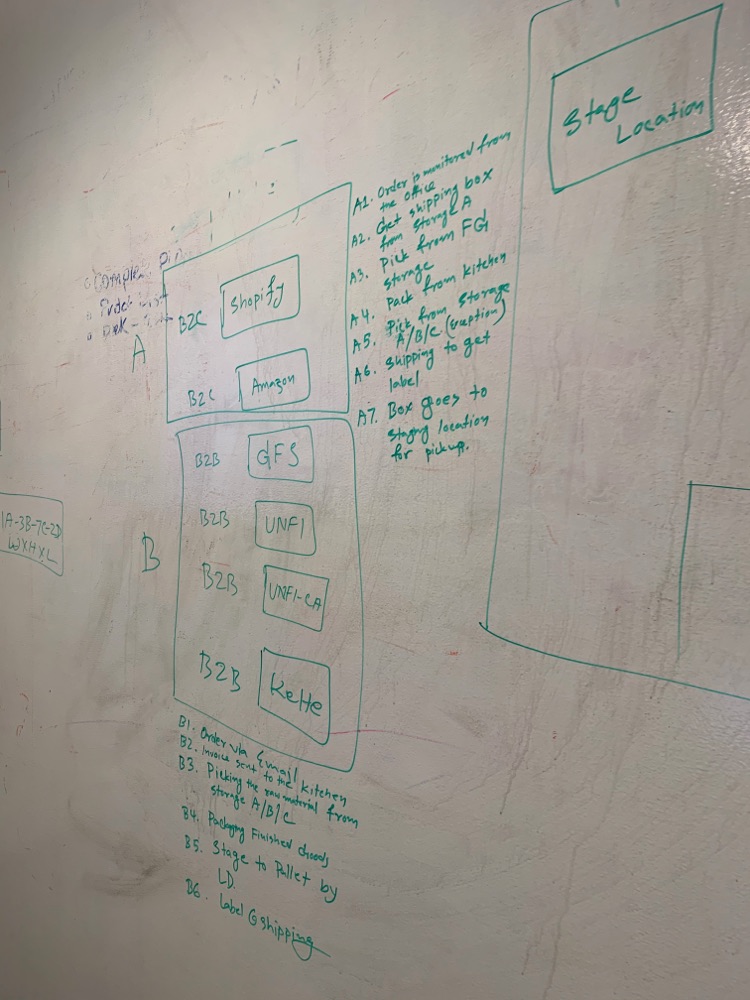
The product was built for resellers, so it didn't yet fit manufacturers, who need raw materials in use tracked separately from raw materials in storage. Users also wanted integrations with suppliers and customers, such as the ERP systems of major distributors.
Depository Works began developing a manufacturer add-on and helping beta customers integrate with suppliers that offered an API or EDI connection.
Usability testing during onboarding
Onboarding new B2B customers for the beta surfaced several problems with how inventory was classified:
- Some users needed pallet dimensions and weights.
- Shipping dimensions could sit in one category instead of four. Someone entering a product's height will enter its width and length too.
- Choosing retail or wholesale up front could fill in the relevant subcategories.
Depository Works revised its onboarding questions to simplify and better organize the classification system.
What carries over
- Interview people where the work happens. The manufacturer's floor plan and order flow came off a whiteboard in their building. It would not have come out of a call.
- Test onboarding before launch, not after. Every classification problem found in the beta was one fewer support ticket at launch.
- Inventory that disagrees across systems is a recurring problem. It is the same problem the precious-metals inventory auditor now checks every morning.